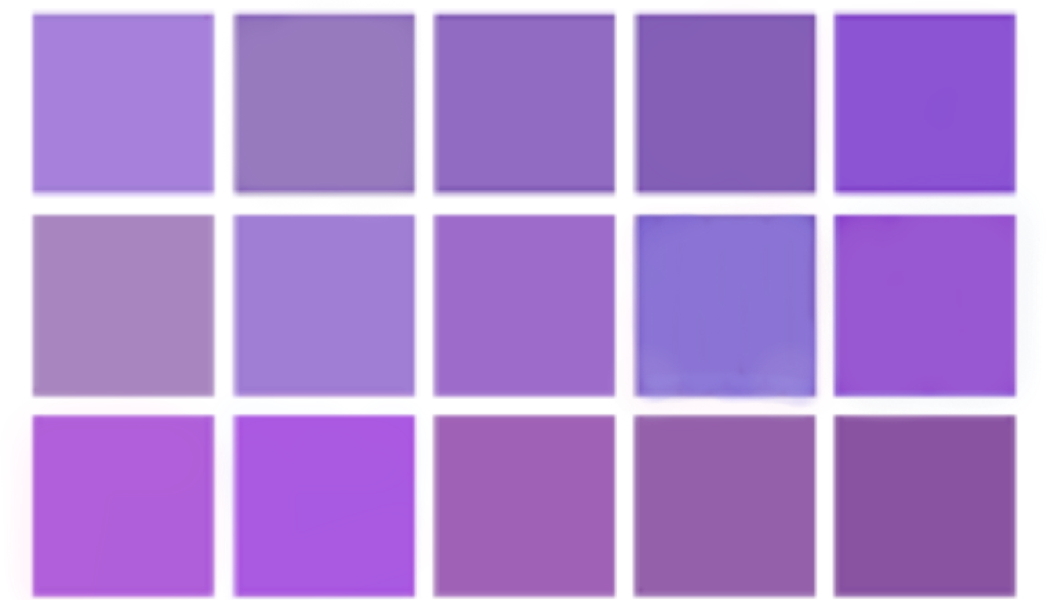
When we were in kindergarten we were taught that the colors above are purple.
This is not true.
“Purple” is a general, and rather simple word that is used for the entire range of these three hue “families” on the color wheel.
These three-
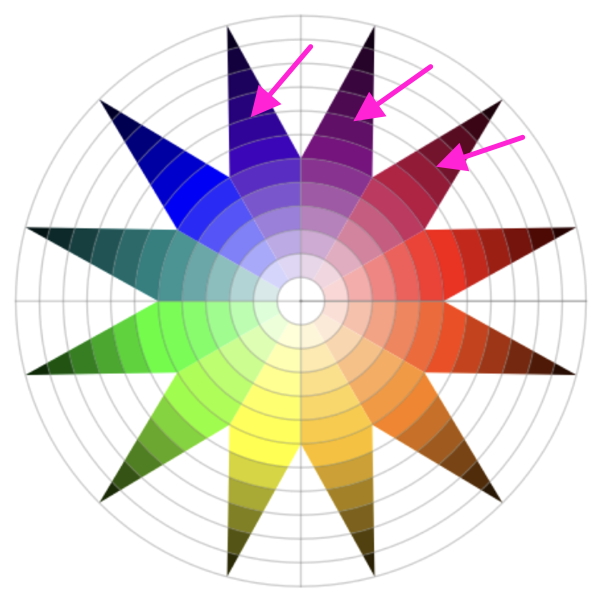
Blue Violet, True Violet and Red Violet. Any color wheel that doesn’t show these 12 hue families and these three clear divisions of violet won’t help too much. I feel like they are a slightly misunderstood area of the color wheel.These three hue families or divisions are drastically different from one another, so thinking of them as separate entities can really help an artist when it comes to using a color harmony effectively. It can also help with temperature issues and creating unity regarding the color of light.
So let’s take my favorite of these hues, (and the trickiest to use) Blue-Violet.
Look at this photo again. Only one swatch falls into the blue-violet category.
Can you spot it?
Yeah, this little guy right here. Why is he different?
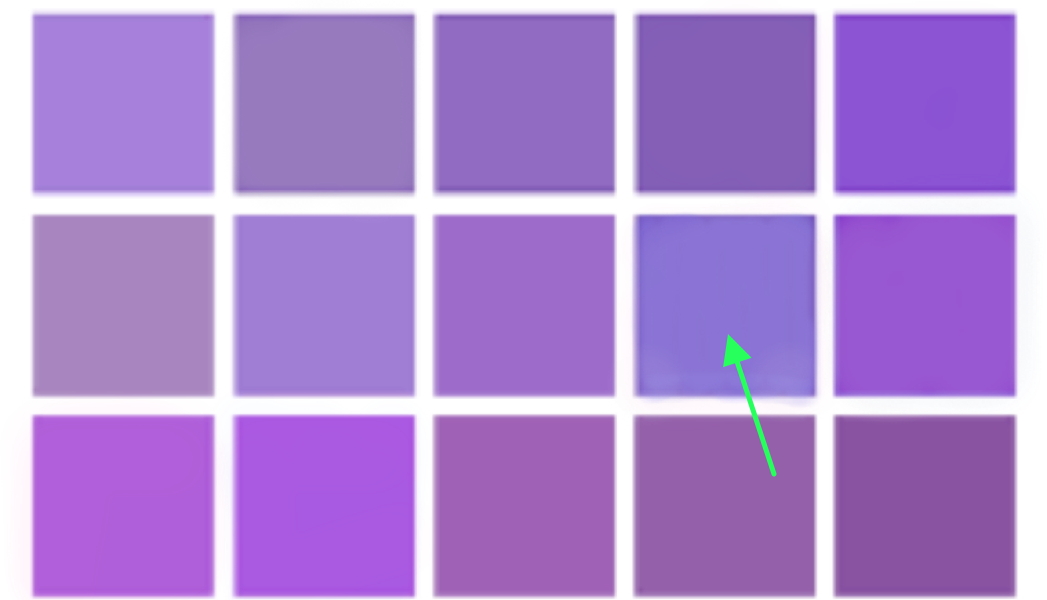
Well, the rest of the colors here fall into a more pure violet- a better balance of blue and red in the mix, or under red-violet- which means that those colors have more of a red dominance. Blue-violet is what it sounds like- a “purple” with a leaning toward a blue dominance the mixture.
As a pastelist I am always hunting and pecking for blue-violet sticks. I will find a ton of blue sticks, a ton of violet or red-violet friends, but the elusive blue-violet is limited. Which makes me want to use it all the more. Ornary me.
When mixing a blue violet variation in oil or acrylic or watercolor the same thing holds true. Color mixtures can easily fall into the true blue or rotate over to its more “purple” cousins. It is a tough hue to hold in a painting. Of course, all colors are not “fixed” and “color sensitivity” assures us that colors will appear to shift and move depending on what colors surround it so it makes it even more tricky to hold the line for blue-violet. But when it holds steady in a painting it can be so lovely, especially with a clear color harmony all working together with it.
Next week I will be looking and looking for reds and oranges. I will be painting the red rocks of Sedona. But I have this sneaky suspicion that I will find a lot of blue-violet in the landscapes there as well. For one, blue-violet is opposite yellow-orange on the color wheel. And I have a sneaky feeling those bright “red rocks” will be proudly showing off a lot of those complimentary colors. So I am making sure to pack my blue-violet sticks. I am bringing oils as well and I will be showing my students how to mix up that lovely color, hold it, and put it to use on our trip as we paint Sedona plein-air.
More on “purple” and the colors of Sedona next week.
Yay for blue violet! So hard to find sometimes, I go – where is that? I would love to see a shot of your box of color. Would that be possible?
sure! I have many drawers setup by power. Not value, not color. This older blog shows my philosophy on how I DON’T sort my sticks. Buckle up!
https://swannportraits.com/chiller-theater/
Loved this!!! Thank you for sharing such great info.
Have fun in Sedona- attended a workshop there years ago. It’s beautiful!
Reminds me of the song by ,Harry Chapin “flowers are red “shared YouTube on Facebook
REALLY LIKE YOUR BLOGS❣️
Thanks! Got the link!
If you want to amaze your students , try this : apply a purple onto a panel or paper .. one with pure color ( lots of chroma). your choice of which purple (try various to see differences )
then ask them how to apply a color atop this ( dry ) purple , if they want a GREEN .
Applying a green , will not produce green . (unless your new pastels do ?)
now apply a mixture of black & white … a mid gray .. atop the purple.
be amazed at the vibrant GREEN
Thanks!